
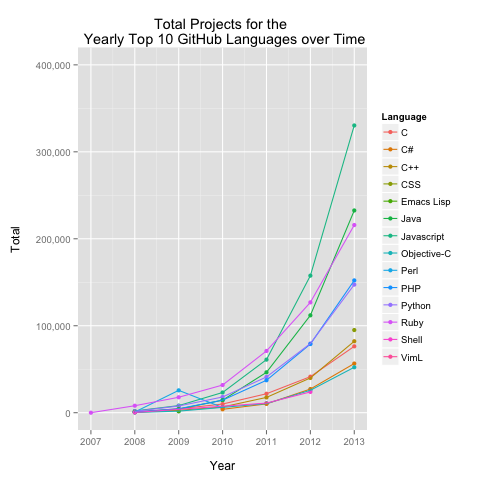
The graphs above display the annual top 10 GitHub languages over time in terms of repos and projects (data source: https://github.com/search/advanced). One important note is that the full history of a language’s presence in GitHub from inception to demise is not shown.
For example, a drop-out in the graph does not necessarily mean that no one is pushing repos or projects in that language anymore but may simply illustrate that the language is no longer ranked in the top 10 for that given year. Of course, the distinction cannot be explicitly tweezed out. Maybe the language has completely vanished! However, we can assume quite confidently that a top 10 language didn’t just suddenly die off. Conversely, a language that pops up is not necessarily a hot “new” language but simply may not have been previously ranked in the top 10.
Example: Shell is not observed in 2013 as it was replaced in the ranks by CSS, which in turn is in existence prior to 2013 but not in the top 10 (and hence not plotted in the graph).
The fun of taking simple numbers such as this and visually plotting the trends is to see if we can tell a story. So, what can we make from these graphs? How do the patterns jive with the known trends in programming languages?
A few starters:
- GitHub started by Ruby programmers.
- Growth of Java from 2011.
- “A significant trend seen in 2011 was the return to Java by several prominent projects. Twitter, for example, joined the Java Community Process, after earlier moving their search architecture from Ruby on Rails to Java/Lucene. Another recent example has been Yammer moving part of their offering from Scala to Java. Other informative posts that provide evidence of resurgent interest in Java include Edd Dumbill‘s O’Reilly Radar posts in advance of OSCON Java 2011. Oracle Technology Network‘s Our Most Popular Tech Articles of 2011 is dominated by Java-related articles.”
- Growth of JavaScript from 2011.
- “2011 was a huge year for JavaScript. First, my citing of Dart, CoffeeScript, and Node.js as “honorable mention” developments (later in this post) and my citing of the year’s biggest winner as HTML5 are evidence in and of themselves of the influence of JavaScript in 2011. Oracle announced at JavaOne 2011 their intention to provide a new server-side JavaScript implementation (Project Nashorn) to illustrate and test non-Java language JVM support and for a high-quality server-side JavaScript implementation that runs on the JVM. jQuery‘s success (and its own 2011 growth) is also another example illustrating the rising prominence of JavaScript.”
 : code me stat :