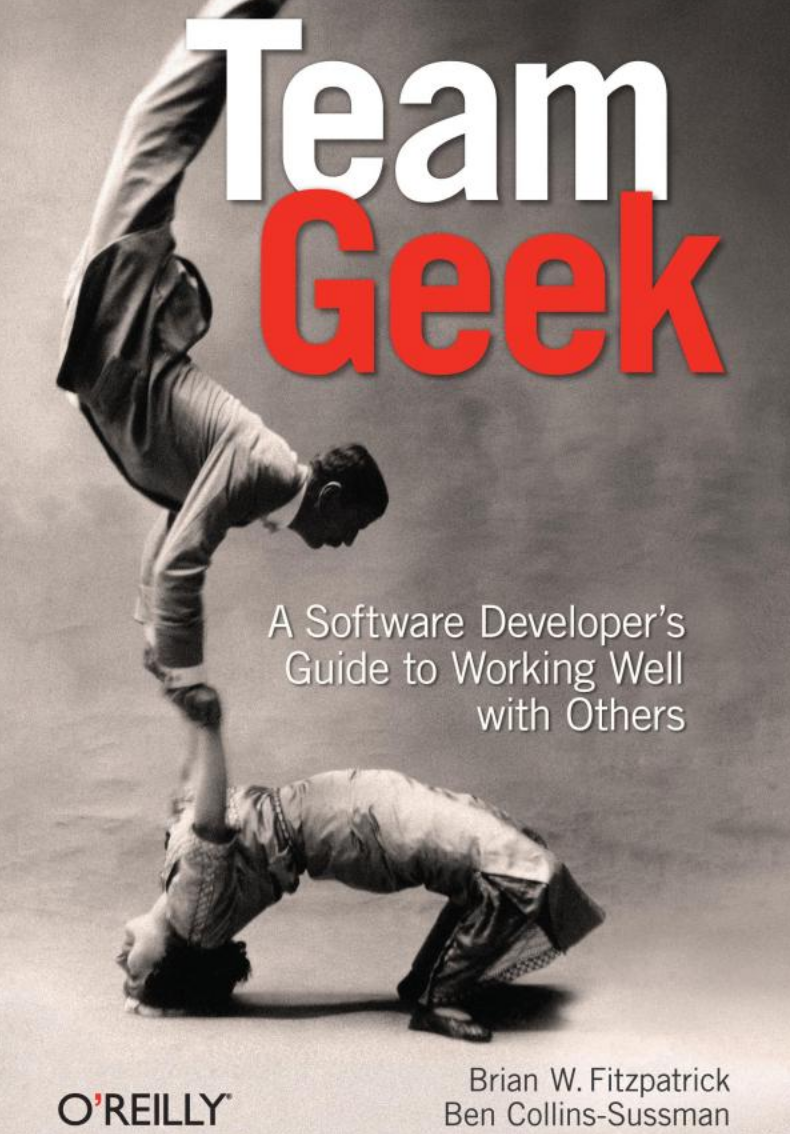
Title: Team Geek – A Software Developer’s Guide to Working Well with Others
Author: Brian W. Fitzpatrick & Ben Collins-Sussman
Contents
- The Myth of the Genius Programmer
- Building an Awesome Team Culture
- Every Boat Needs a Captain
- The Art of Organizational Manipulation
- Users are People, Too
Mission Statement
“The goal of this book is to help programmers become more effective and efficient at creating software by improving their ability to understand, communicate with, and collaborate with other people.” (xiii)
Team Geek is a light and fun read with insightful commentary on how marrying the human “soft skills” with the technical “hard skills” can create the foundation for a great team. While Team Geek is written for software engineers (and their managers) in mind, its takeaways are relevant to anyone — engineer or non-engineer, lone wolf or team player. Though common sense at times with lessons already picked up from experience, what makes this book worth the read is the packaging of these lessons as entertaining stories and analogies like:
- “Strengthen what we call the bus factor … the number of people that need to get hit by a bus before your project is completely doomed” (7)
- “Your team’s culture is much like a good loaf of sourdough” (27)
- “A boat without a captain is nothing more than a floating waiting room” (54)
- “Engineers are … like plants: some need more light, and some need more water (and some need more bullshit, er, fertilizer).” (81)
Three Core Principles
The building blocks for a great team are based on “three pillars” of social dynamics: Humility, Respect, Trust — or HRT (12).
- Humility: “You are not the center of the universe. You’re neither omniscient nor infallible. You’re open to self-improvement.”
- Respect: “You genuinely care about others you work with. You treat them as human beings, and appreciate their abilities and accomplishments.”
- Trust: “You believe others are competent and will do the right thing, and you’re OK with letting them drive when appropriate.”
What does this mean in practice? Actions of HRT include:
- lose the ego
- learn to both deal out and handle criticism
- fail fast; learn; iterate
- leave time for learning
- learn patience
- be open to influence
Using anecdotes and accompanying illustrations, the authors emphasize the importance of HRT not only for one’s own growth but for the success of the larger team. While the rare specimen of a “unicorn” or “lone craftsman” may exist, none of us work in a vacuum. Successful leaders are especially important in managing the team – particularly when attacked from within by poisonous threats (e.g., ego, over-entitlement, paranoia, perfectionism). Patterns (and anti-patterns) adopted by leaders to build a resilient (or dysfunctional) team are collected from first-hand accounts:
Antipattern (for Unsuccessful Leadership)
- Hire pushovers
- Ignore low performers
- Ignore human issues
- Be everyone’s friend
- Compromising the hiring bar
- Treat your team like children
Pattern (for Successful Leadership)
- Lose the ego
- Be a Zen master
- Be a catalyst
- Be a teacher and a mentor
- Set clear goals
- Be honest
- Track happiness
All in all, HRT must be taken to heart by each and every team member in all interactions, big and small.
What I took to heart
As I find myself in a transitional phase seeking to learn what I am lacking (currently be on a team of a lonely one without strong leaders and mentors to learn from) and what I am searching for to find that happy spot in a Team Geek, the following resonated with me:
- “If you spend all your time working alone, you’re increasing the risk of failure and cheating your potential for growth.” (5)
- “Working alone is inherently riskier than working with others. While you may be afraid of someone stealing your idea or thinking you’re dumb, you should be much more scared of wasting huge swaths of time toiling away on the wrong thing.” (10)
- “Your self-worth shouldn’t be connected to the code you write. To repeat ourselves: you are not your code.” (17)
- “Let’s face it: it’s fun to be the most knowledgeable person in the room, and mentoring others can be incredibly rewarding. The problem is that once you reach a local maximum on your team, you stop learning. And when you stop learning, you get bored. Or accidentally become obsolete. It’s really easy to get addicted to being a leading player; but only by giving up some ego will you ever change directions and get exposed to new things. Again, it’s about increasing humility and being willing to learn as much as teach. Put yourself outside your comfort zone now and then; find a fishbowl with bigger fish than you and rise to whatever challenges they hand out to you. You’ll be much happier in the long run.” (20)
Even if we think we can stand on our own and detach from the human dramas, software engineering (and essentially all personal relationships and professional endeavors) is a team sport and in order for us all to win, especially in the trenches of conflict and bureaucracies, everyone must play the game by the social rules: Humility, Respect, and Trust.
* * * * *
Check out Fitzpatrick & Collins-Sussman’s Google I/O 2009 talk “The Myth of the Genius Programmer”: http://youtu.be/0SARbwvhupQ
 : code me stat :